
Why Serious Golfers Are Finally Taking Simulators Seriously
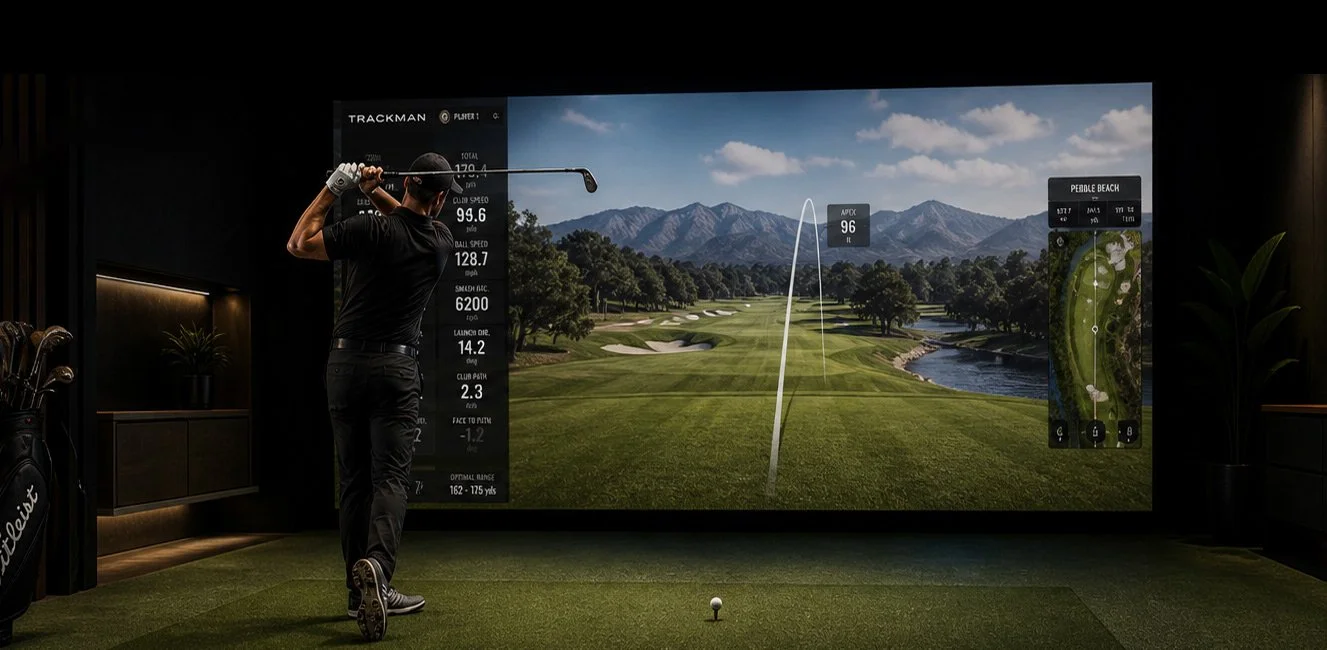
For a long time, serious golfers didn’t trust simulators.
They were seen as entertainment—something you’d use in the offseason to keep the swing loose, not something you’d rely on to actually improve. The feedback felt off. Distances weren’t quite right. And most importantly, the stakes didn’t feel real.
That mindset is changing fast.
Today, some of the most dedicated players—scratch amateurs, competitive juniors, even tour professionals—are spending more time in simulators than ever before. Not because they have to… but because it works.
The End of “Guessing” Your Swing
Traditional practice has a fundamental flaw: it’s largely based on feel.
You hit a shot, watch the ball flight, and make an educated guess about what just happened. Maybe you pushed it. Maybe you came over the top. Maybe your face was open.
But “maybe” doesn’t lower your handicap.
Modern launch monitors from companies like TrackMan and Foresight Sports eliminate that uncertainty entirely.
They tell you—precisely:
Club path (to the decimal)
Face angle at impact
Spin axis and launch conditions
Smash factor and ball speed
You’re no longer interpreting ball flight. You’re diagnosing cause and effect in real time.

Practice With Consequences
One of the biggest criticisms of simulators used to be that they didn’t “feel like golf.”
That’s changed—and it comes down to software.
Platforms like GSPro and E6 Connect now model:
Punishing rough that actually kills spin
Firm greens that reject poor approach angles
Wind conditions that influence ball flight realistically
In other words: bad shots get punished.
That matters more than people realize. Because real improvement doesn’t come from hitting perfect shots—it comes from learning how your mistakes behave.
You Can Finally Practice the Shots That Matter
Think about how most people practice at a driving range:
Flat lies
Repetitive full swings
No real pressure
No context
That’s not golf. That’s a narrow slice of golf.
Inside a simulator, you can:
Play full rounds on championship courses
Hit approach shots from 137 yards repeatedly until you dial it
Practice uneven lies and awkward distances
Recreate pressure by playing matches or tracking scores
You’re not just working on your swing—you’re training your decision-making.
Immediate Feedback = Faster Improvement
Here’s where simulators separate themselves completely from traditional practice.
Feedback loops.
On a course, you might hit 30–40 meaningful shots in a round. At a range, maybe you hit 80 balls—but without precise feedback, many of those reps don’t translate into improvement.
In a simulator session, every single shot gives you:
Measurable data
Visual ball flight
Instant cause-and-effect relationships
That compression of feedback accelerates improvement in a way that outdoor practice simply can’t match.
The Best Players in the World Are Already Doing It
This isn’t theoretical.
Players at the highest level use simulators and launch monitors daily—not as a replacement for on-course play, but as a critical part of their training.
Why?
Because when you’re trying to refine a swing at an elite level, guesswork isn’t acceptable. You need precision. You need repeatability. And you need to know exactly what changed when something clicks—or breaks.
The Environment Matters More Than You Think
Here’s the part most people overlook: Even the best technology won’t help you if the environment is wrong.
Ceiling height, room depth, lighting control, hitting surface, screen quality—these all directly impact:
How freely you swing
How accurately data is captured
How realistic the experience feels
A cramped or poorly designed setup creates subtle swing compensations. A properly designed space lets you swing naturally—and trust the results.
That’s the difference between a simulator you “use occasionally” and one that becomes part of your routine.
It’s Not Replacing Golf—It’s Enhancing It
Let’s be clear: simulators aren’t replacing real golf.
They’re making your time on the course more effective.
Instead of using rounds to “figure things out,” you show up with:
A dialed-in yardage matrix
A better understanding of your misses
More confidence in your swing
And that changes everything.
The Bottom Line
Serious golfers used to dismiss simulators because they weren’t good enough.
Now, the opposite is becoming true: if you’re serious about improving, it’s getting harder to justify not having access to one.